Everything in the campus, in detail.
Lessons, live classes, peer practice, marking and progress, all reading from one ledger that turns every mistake you make into your next lesson.
01Blackboard lessons
A lecture that stops when you do.
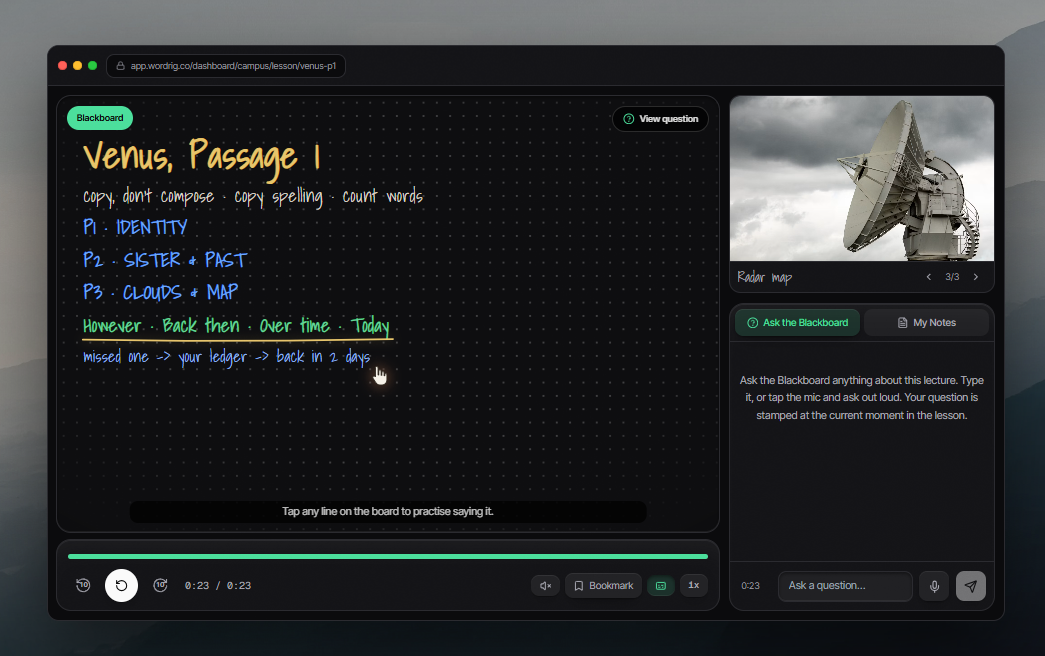
Every campus lesson is a narrated blackboard: the voice writes, strikes and draws on the board in time, and you can stop it at any line to practise, take notes or ask.
- synced to the voice
- 1 board
- characters per timestamped note
- 280
- until a missed question returns
- 2 days
Pause on any line
Click a board line to practise saying it, then carry on from the same moment.
Ask the board
Ask by voice or text, and the answer is written on the board, stamped at that point in the lesson.
Questions inside the lesson
Inline checks such as one-word summary completion, marked the moment you answer.
Misses go to the ledger
A wrong answer is filed under its micro-skill and comes back in two days.
02Live cohorts
Real teachers, always in session.
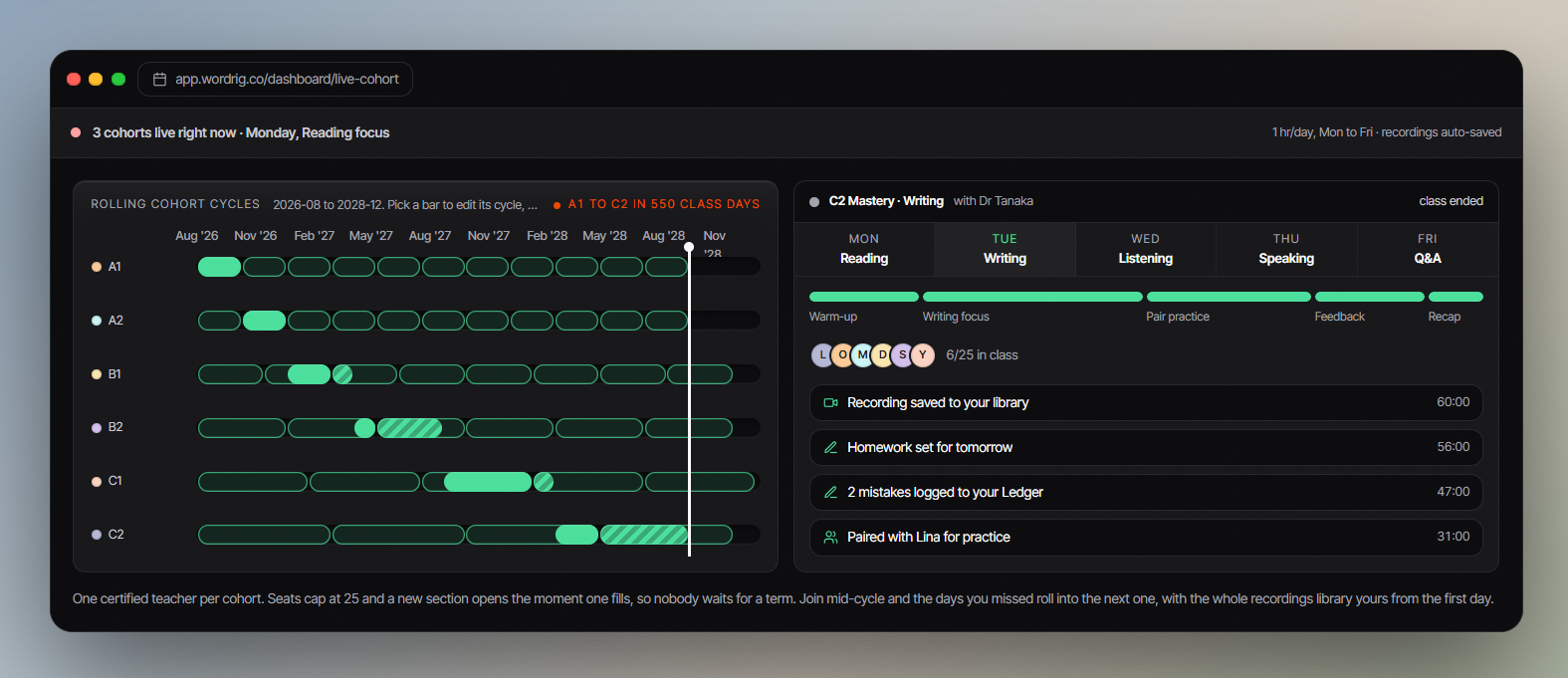
Six cohorts run in parallel, one per CEFR level, an hour a day with a certified teacher. Join on any weekday and move up mid-stream when your work says you are ready.
- cohorts, A1 to C2
- 6
- a day, Monday to Friday
- 1 hr
- seats per section
- 25
A skill a day
Reading on Monday, Writing, Listening, Speaking, then a Friday Q&A.
A class with a shape
Warm-up, skill focus, pair practice, feedback and a recap, in sixty minutes.
Nothing lost
Recordings save to your library, and mistakes from class go straight to your ledger.
Homework that follows
Each class sets tomorrow's homework from what happened in the room.
03Remedial lessons
Every mistake, from every room, composed into your lesson.
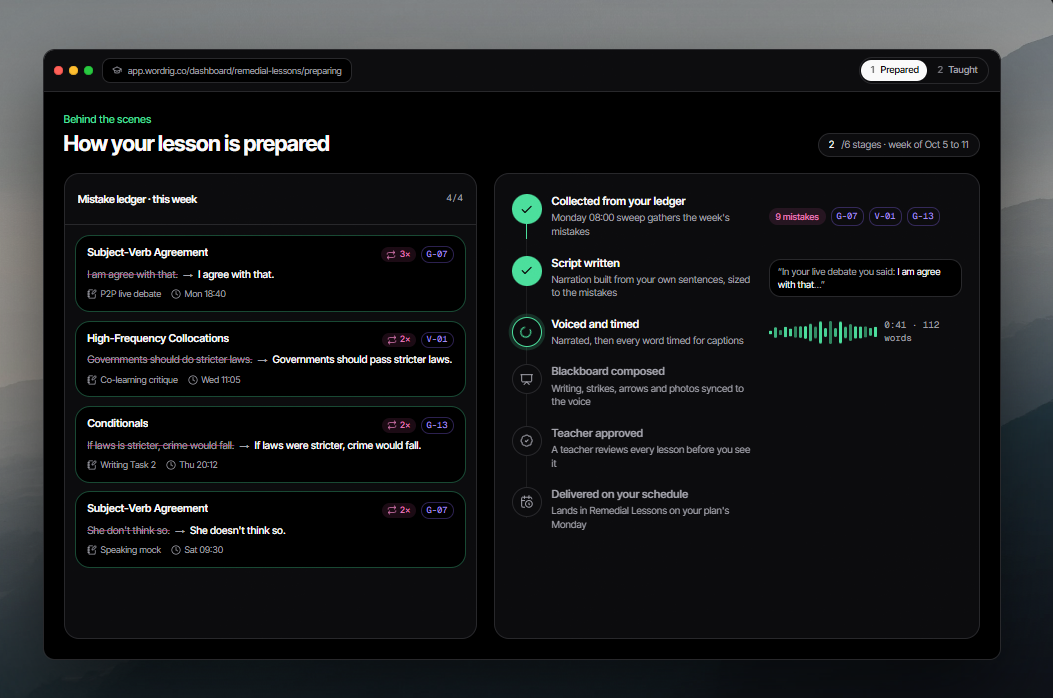
Errors are tagged with a micro-skill wherever they happen. Each week they collect in your ledger, a teacher approves the lesson built from them, and it arrives as a narrated blackboard lesson in your own sentences.
- weekly ledger sweep
- Mon 08:00
- of lessons teacher-approved
- 100%
- every example is yours
- Your words
Collected
Slips from P2P debates, co-learning critiques, writing tasks and speaking mocks, gathered in one sweep.
Scripted from you
The script is written from your own sentences, then voiced and timed for captions.
Composed on the board
Writing, strikes, arrows and photos are synced to the voice, like any campus lecture.
Delivered on schedule
A teacher reviews it, and it lands in Remedial Lessons on your plan's Monday.
04Peer practice
Watch both screens before it counts.
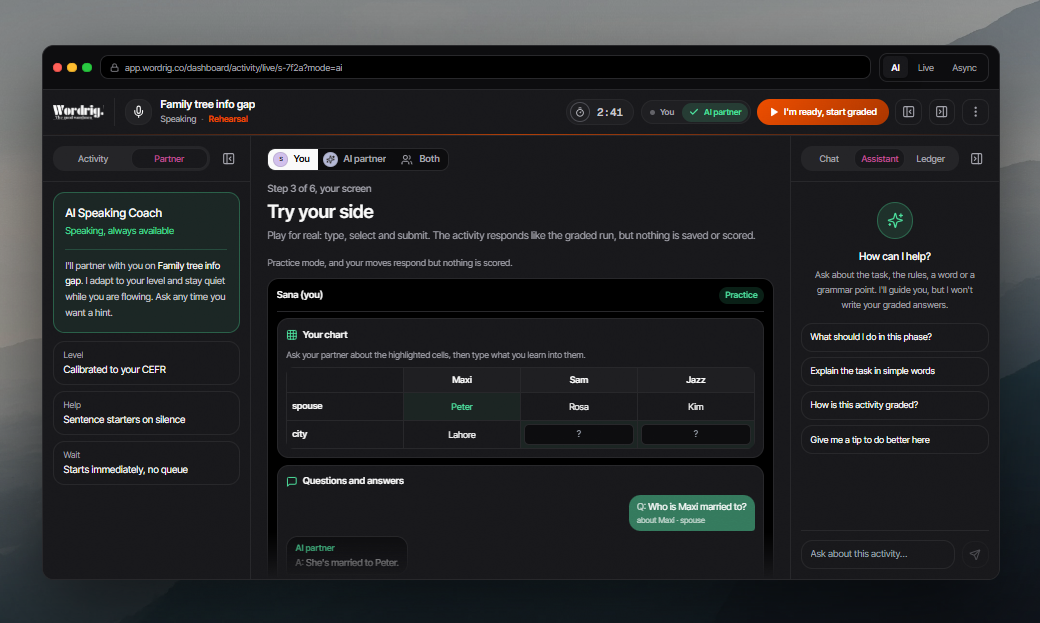
Every peer activity opens in rehearsal. Nothing is scored yet: explore your side, see your partner's, then you both press ready and the graded run begins.
- modes: AI, live or async
- 3
- phases per activity
- 5
- scored dimensions
- 3
Never an empty seat
Play live with video, async in a thread, or with an AI partner that plays for real.
Rehearse first
Six guided steps show how the activity works and what the scorer grades, before anything counts.
A run with phases
Exchange, verify, retry and debrief, each on its own timer, so the gain sticks.
Scored per person
Accuracy, question quality and interaction, with your own debrief and your partner's.
05Co-learning rooms
A shared whiteboard, in a live room.
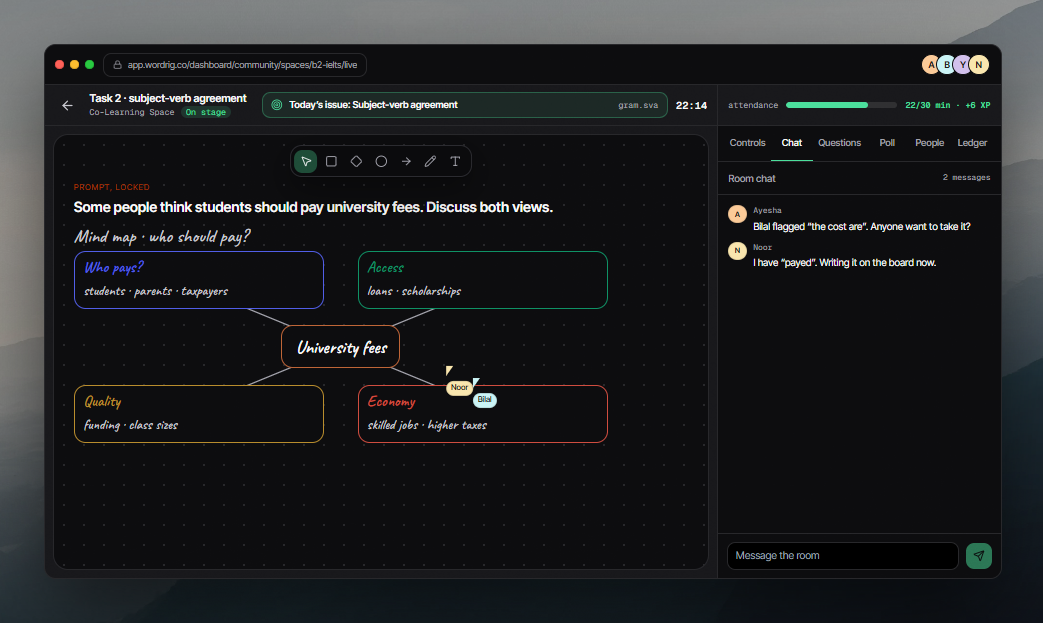
Learners meet around one canvas to fix shared mistakes. Vote on what to fix first, correct it together, and every correction files straight to your ledger.
- board templates
- 14
- stage seats plus a gallery
- 7
- every change synced
- Live
Templates for the task
Error-hunt boards, debate ladders, T-charts, info-gap grids, mind maps, timelines and more.
Run by supervisors
A lead supervisor and supervisors keep the room on task from the stage.
Vote, then fix
Dot-vote polls decide which paragraph or error the room works on first.
Timed question rounds
Moderators post rounds from the drill and mock bank, and answers are AI-graded.
06Question formats
Every question format, sorted by skill.
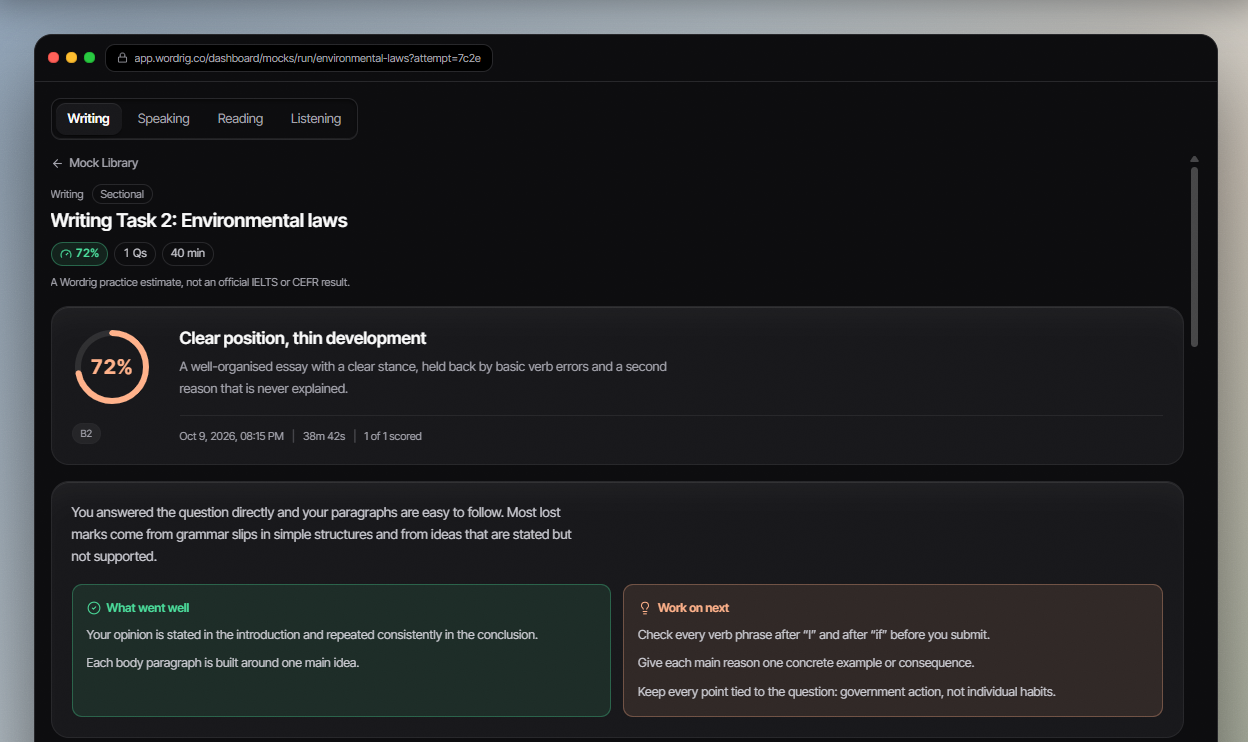
Twenty-four formats run across drills, mocks and pop-up quizzes. Tap, type, drag, write and record, each with its own feedback stage after you answer.
- question formats
- 24
- skills covered
- 6
- places they appear
- 3
Exam-shaped
True / False / Not given, matching headings, map labelling, flow-charts and table completion.
Grammar and vocabulary
Error correction, key-word transformation, collocation grids, cloze and crosswords.
Production
Task 1 and Task 2 essays and Parts 1 to 3 speaking, recorded and band-scored.
Feedback on every one
Question, answer, then feedback, so each attempt teaches as well as tests.
07Flashcards
Six ways to meet a word, one schedule to keep it.
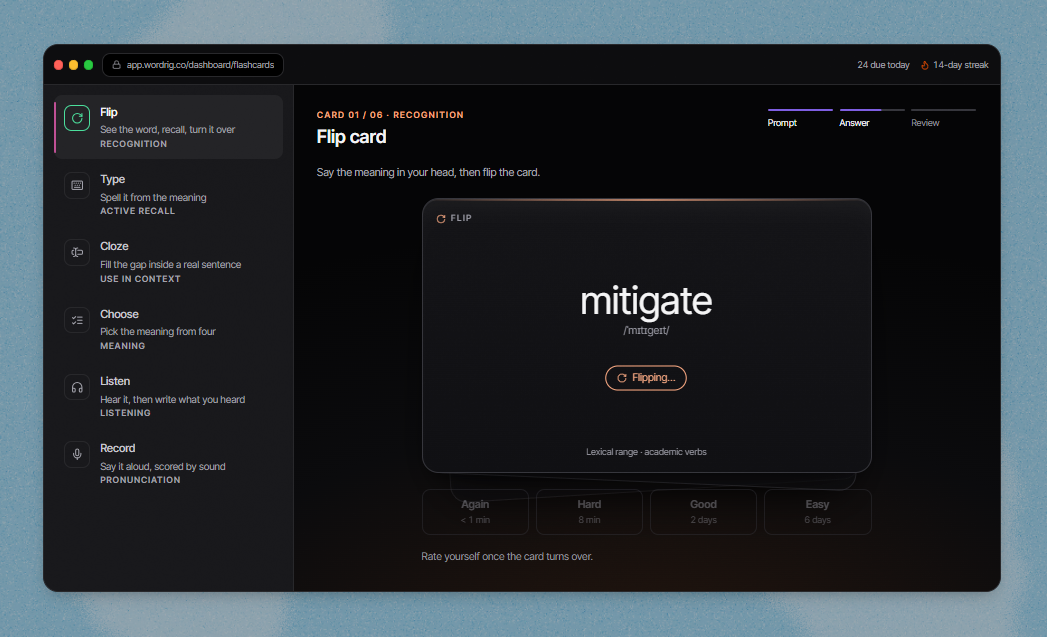
Every card is built for one job: recognise it, recall it, use it, hear it or say it. FSRS spaces each review just before you would forget, and the slips from your mocks and drills become cards on their own.
- card types
- 6
- spaced repetition
- FSRS
- ratings per review
- 4
Flip and choose
Recognition and meaning, for the words you are only starting to know.
Type and cloze
Active recall and use in context, often built from your own mistakes.
Listen and record
Hear a word, then say it and get a pronunciation score per syllable.
Again, Hard, Good, Easy
Your rating sets the next interval, from under a minute to days away.
08Micro-skill map
One slip, and the whole campus goes to work.
Every surface tags your work in the same 112-skill vocabulary, so a mistake you make in speaking is what your flashcards drill tonight.
- tracked micro-skills
- 112
- skill families
- 7
- band, typical per skill cleared
- +0.4
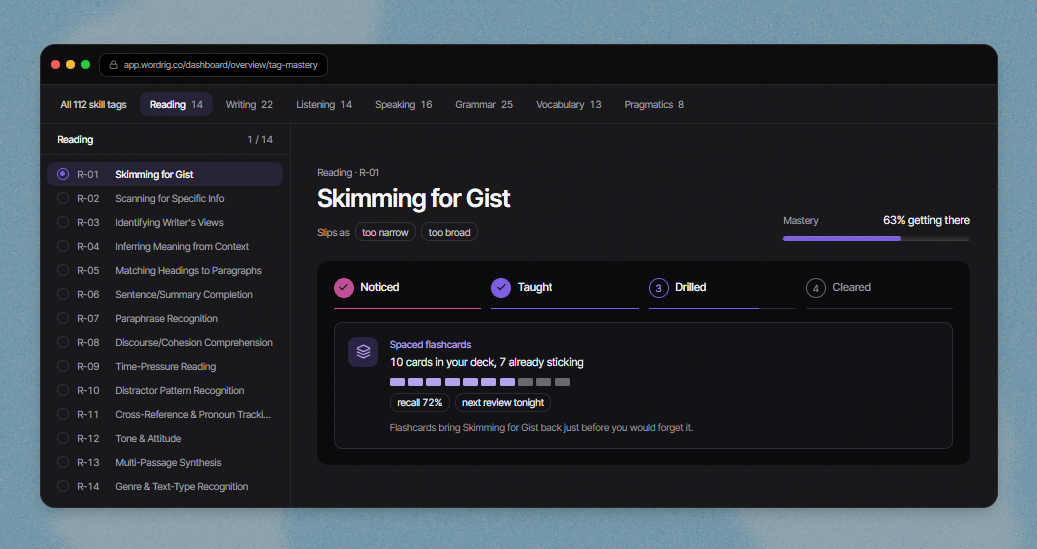
Noticed
Grading tags the slip with its skill and files it on your ledger.
Taught
Today's blackboard lesson is rebuilt around that skill.
Drilled
Flashcards bring it back just before you would forget it.
Cleared
When it holds up in a re-test, it comes off the ledger and you move on.
09Marking and feedback
Feedback that reads like a teacher's markup.
After every mock you get an overall verdict, a band for each criterion, numbered corrections and examiner feedback on every question, across all four papers.
- papers marked
- 4
- criteria per paper
- 4
- teacher review when unsure
- <24h
Band per criterion
Task Achievement, Coherence and Cohesion, Lexical Resource, Grammatical Range and Accuracy.
Numbered corrections
Each fix is named: underdeveloped idea, mechanical linking, unidiomatic phrase, verb form.
Speaking, measured
Fluency, vocabulary, pronunciation and grammar, with words per minute and a band.
A human backstop
When the model is not confident, the work routes to a certified teacher.
10Contribution XP
Climb together, and pull someone up with you.
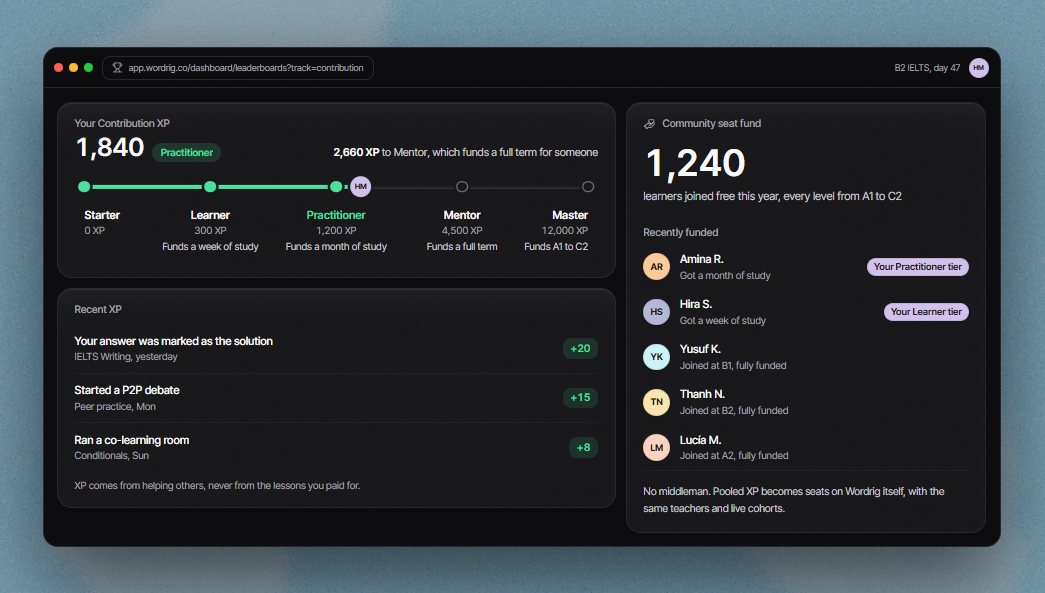
The XP you earn helping other learners funds free seats for people who cannot pay, from A1 to C2, with the same teachers and live cohorts.
- contribution tiers
- 5
- learners funded this year
- 1,240
- middlemen
- 0
Earned by helping
Answer marked as the solution, start a P2P debate, run a co-learning room.
Never from paid lessons
XP comes from helping others, never from the lessons you paid for.
Tiers that fund study
Learner funds a week, Practitioner a month, Mentor a full term, Master A1 to C2.
Seats on Wordrig itself
Pooled XP becomes real places in the same cohorts you study in.